
Agenda Setting
What came first, the chicken or the egg? Something no one seems to be able to agree on. In my opinion, agenda setting. Agenda setting is a media-research argument that says that when the mass media pay attention to particular events or issues, they determine-that is, set the agenda for-the major topics of discussion for individuals in society. So clearly, the book has decided it’s the chicken first with the public deciding what events they believe are important, and that decides what will be played on the news. However looking at the sports news show Sports Center, I’d present the argument that the egg needs to first hatch to have the chicken. Through research and personal experience, I believe that due to what the media, more specifically sports center shows, the public decides what is important, due to what is available.
For those that are not necessarily most up to date with the sporting world, we are currently in the midst of an NHL playoffs where a number 8 seed knocked off a 1, there were a record number of over-time games and some of the most intense fights thus far this season. Not to mention we are also just beginning the NBA playoffs from one of the most influential season since the mid ‘90s. Add on top of that the first month of MLB has just wrapped up complete with a 19-year old star and the first Japanese pitcher in the majors, Yu Darvish. Yet what were the first several stories about? The NFL draft, coverage for a sport that is not currently in-season. Also add in to that a part about Eli Manning appearing on Saturday Night Live, that deserves to go before the over-time upset win in Los Angeles for the LA Kings, right?
Football is currently the most popular sport in America (Pro Football Continues…). With nearly 31 percent of all sports fans agreeing football is their favorite it is 14 percent above the next closest, baseball, then followed by college football. But why is that? Baseball, for being at number two currently, since 1985 has actually decreased 6 percent. Maybe that’s because in this year’s NFL’s draft, ESPN had full coverage for two-days. That means “sorry” to any MLB team that had a game April 24-25 because Sports Center was covering an off-season NFL moment (Deitsch). Baseball is down in popularity while football grew 7 percent. (Pro Football Continues…).
In my journalism course, here at the University of Missouri, we learned 95 percent of television viewers obtain their news information from what they see on television. Let’s take Tim Tebow for a recent example. Tim Tebow, the former Broncos, now Jets quarterback, this past NFL season
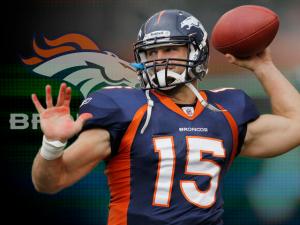 was nothing short of a celebrity. Was that because people enjoyed watching him play, or because he was a majority of the subject matter on ESPN for nearly the entire season? Tim Tebow completed 126 passes in the 2011 regular season for a total of 1,729 yards (ESPN). Alex Smith, the 49ers quarterback had 273 completions for 3,144 yards. In one episode of Sports Center, Tim Tebow was mentioned 154 timeswith NFL taking up 40.2 percent of the entire episode (Burns). Smith was mentioned 25 times, which is more than most other league quarterbacks. “ESPN spent 30 minutes of coverage focused solely on Tim Tebow, including a segment on Tim Tebow as a superhero, complete with a comic commissioned by Marvel and a hockey highlight where a player Tebowed” (Burns). It may be easy to see the difference when pointed out between a comic-strip hero and actual news, but to the average viewer as these two thoughts are shown back to back, the separation seems minimal.
In this argument however, I have left out the cardinal sin that Sports Center and ESPN themselves are guilty of; I left out the NHL completely. On that same Time Tebow special of Sports Center, the National Hockey League was in the midst of their regular season. The league was granted less than three percent of airtime on Sports Center. So again, is it the chicken or the egg? Is it that Americans aren’t interested in hockey, so it isn’t aired, or is that hockey is never aired so it is difficult to follow and be a fan?
There’s a drastic difference between the word relevant and the word important. Both are left out of the books definition of agenda setting, but both have a very prominent role in just that. Larry Brown, ten years of sports media experience, said it perfectly in “ESPN might not determine what sports are important for YOU, but they determine what sports are relevant — they set the agenda” (Brown). So the thought is out there that both parties can create agenda setting scenarios. The public can decide what they feel is important and the media will replicate that for their main features. Or the media can place the stories they find most relevant, which then affects the way the audience perceives news, or rather what is news.
 mollycarlino
Leave a comment